The calculator above adds up the losses you enter, takes off your share of the fault under the rule we read for your state, and sets what’s left beside the at-fault driver’s policy limit. It’s arithmetic on your own numbers. It doesn’t say what your claim is worth or what anyone will pay, because no tool can know that and no public data shows it. It belongs to our guides on what a claim is made of and how it gets valued.
This page is general information, not legal, tax or medical advice, and not a substitute for the advice of an attorney. Injury law and deadlines vary by state and change. Ask a lawyer or the court about your situation.
Most “settlement calculators” online take your medical bills, multiply them, and show a range. This one does two things they usually skip or get wrong: the state’s fault rule, read in its statute or a court opinion, and the policy limit. Those two steps can matter more than any multiplier. A 51% share of fault in Texas, or 1% in Virginia, can take the figure to nothing, and a $30,000 per-person limit caps what that policy pays one injured person, whatever the losses add up to.
How to use the calculator
- Economic losses: losses with a bill or a pay stub behind them: medical bills, lost pay, and other costs the injury caused. Leave out repairs to your car. Car damage is paid under the policy’s separate property damage limit, so mixing it in would distort the limit lines.
- Non-economic losses: pain, suffering and similar harm that has no receipt. No law sets this number, and you can enter 0. If you want a starting point, the pain and suffering calculator runs the two methods people use, and explains why neither is a rule.
- Your share of the fault: a whole percentage you enter to see what it does. In a real claim it is negotiated with the insurer or decided by a jury or judge, and it is often the most disputed number in the file.
- State: picks the fault rule we read. The list holds the 36 states whose rule we could read in an official source on 6 November 2026. New York, Florida and Louisiana are split because their rules changed: New York for car crash injury suits filed from 26 May 2026, Florida for suits filed after 24 March 2023, Louisiana from 1 January 2026. The earlier Florida and Louisiana cases we haven’t read, so they show “not confirmed”. Every other state and DC sits under one “not confirmed” choice.
- Bodily injury limit, per person: the most the at-fault driver’s policy pays for one injured person. Enter 0 if you don’t know it, and the limit lines won’t cut anything.
The results show, in order: the losses you entered, your fault share of them, the figure after your state’s rule, the rule number, the part within and above the limit, and then the same losses under each kind of rule. The last rows let you see what the rule itself changes. Every result is an estimate built only from what you typed.
What the rule number means
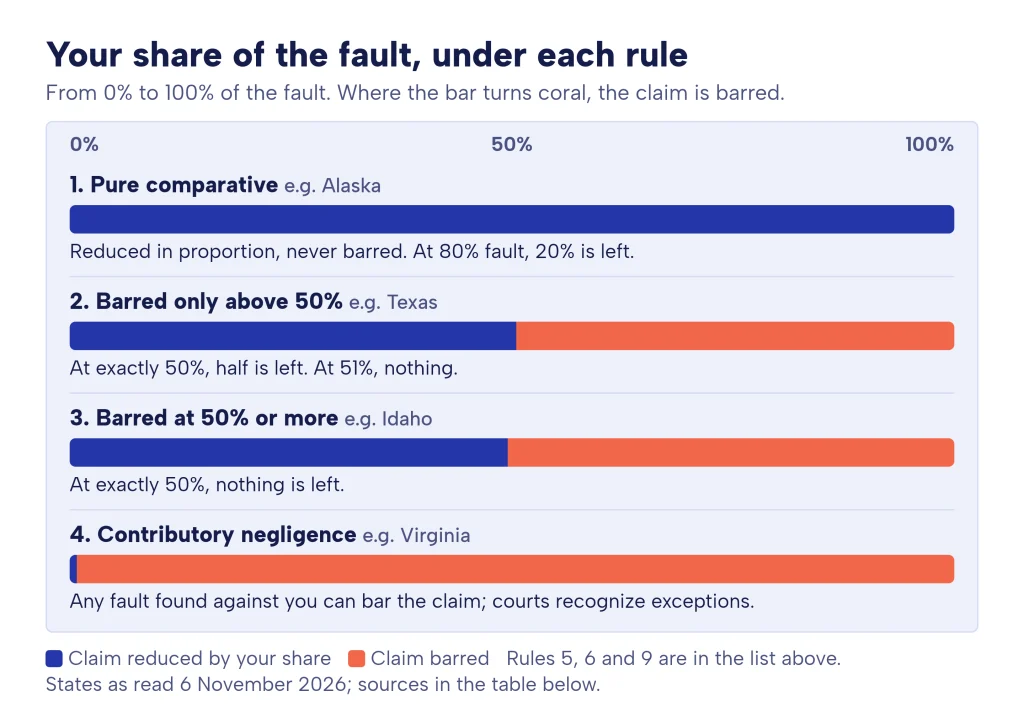
- 1, pure comparative. Your fault reduces the losses in proportion and never bars the claim. At 80% fault, 20% is left.
- 2, barred only above 50%. Reduced in proportion, and barred once your fault is greater than the other side’s. At exactly 50%, half is left. Lawyers often call this the 51% bar.
- 3, barred at 50% or more. Reduced in proportion, and barred unless your fault is less than the other side’s. At exactly 50%, nothing is left. This is often called the 50% bar.
- 4, contributory negligence. Any fault found against you can bar the claim. The courts that keep this rule recognize exceptions, which the tool can’t weigh.
- 5, Michigan. Reduced in proportion. Above 50%, only economic losses are reduced and paid, and non-economic losses are not awarded.
- 6, a jury’s judgment. Maine and South Dakota use words the tool can’t turn into arithmetic, so the state line shows $0. Read the rule numbers 1 to 3 instead, and see the table below.
- 9, not confirmed. We couldn’t read an official source for the state’s rule, or for the kind of case you picked, so the state line shows $0. That $0 is not a finding that you’d get nothing. Look at the numbered rule rows, then check with the state’s courts.
The tool treats everyone else as one party. Several states compare your fault with that of each defendant or with all of them together, and some count people who aren’t in the case. With two or more other drivers, the comparison can come out differently from the one the tool makes.
A worked example
This page is general information, not legal, tax or medical advice, and not a substitute for the advice of an attorney. Injury law and deadlines vary by state and change. Ask a lawyer or the court about your situation.
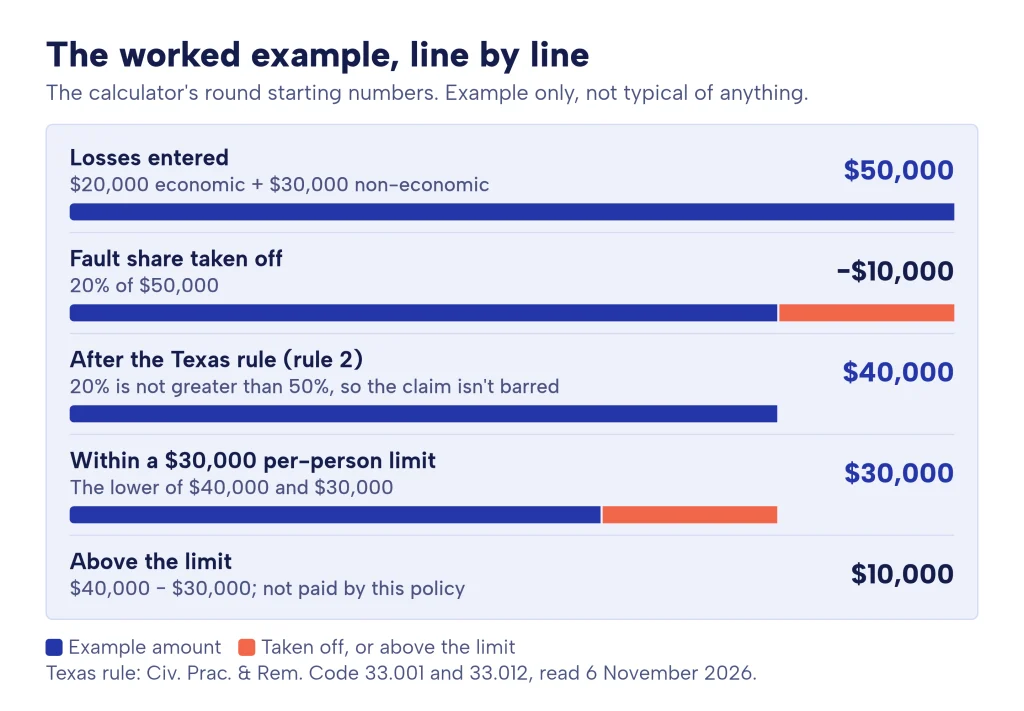
These are the calculator’s starting numbers, chosen as round examples. They are not typical of anything. Say someone in Texas enters $20,000 of economic losses, a non-economic figure of their own of $30,000, a 20% share of the fault, and a $30,000 per-person limit.
| Step | Working | Example figure |
|---|---|---|
| Losses entered | $20,000 + $30,000 | $50,000 |
| Fault share taken off | 20% of $50,000 | −$10,000 |
| After the Texas rule (rule 2) | 20% is not greater than 50%, so the claim isn’t barred | $40,000 |
| Within a $30,000 limit | The lower of $40,000 and $30,000 | $30,000 |
| Above the limit | $40,000 − $30,000 | $10,000 |
Now change one number at a time. At 50% fault, Texas still allows half, $25,000, while Idaho’s rule (rule 3) gives nothing. At 51%, both give nothing. In Virginia, entering 1% fault takes the state line to $0. In Michigan at 60% fault, only the economic $20,000 is counted, reduced to $8,000 (MCL 600.2959; for a car crash, see the no-fault note further down). The losses haven’t changed in any of these. Only the rule has.
Why there’s no “settlement value” here
Many calculators finish by turning a sum into a “likely settlement” range. We don’t, for three reasons.
- There’s no public record of settlements to base it on. We looked for a national dataset of settlement amounts and found none. The Bureau of Justice Statistics explains why: the terms of cases settled before trial “may not be reported to the court or may not be publicly available” (BJS, Civil Bench and Jury Trials in State Courts, 2005). The nearest national figure is from that study: a median award of $15,000 in automobile cases, but only for trials, only for plaintiffs who won money, and only in 2005, 21 years ago. It says nothing about settlements, and we don’t use it as a guide to any claim. The public records that do show real settlement amounts, and their limits, are in personal injury settlement examples.
- The multiplier is a habit, not a rule. You may see “pain and suffering is 1.5 to 5 times the medical bills” on law firm pages. We looked for a study or a statute behind it and didn’t find one.
- A “discount” to a settlement range is a guess about one insurer’s behavior. Nothing public tells us how far below its own valuation any insurer settles.
What a reader can know is the rule and the limit. That’s what this tool works on.
Fault rules by state, as we read them
Each row was read in the official statute, or in a state supreme court opinion where the rule is case law, on 6 November 2026. The wording column paraphrases the text. Follow the link for the exact words, and for exceptions further down the section. For more detail state by state, see our fault rule lookup for all 50 states.
| State | Rule | Law read |
|---|---|---|
| Alaska | 1 | AS 09.17.060 |
| Arizona | 1 | ARS 12-2505 |
| California | 1 | CACI No. 405, 2026 edition |
| Connecticut | 2 | C.G.S. 52-572h(b) |
| Delaware | 2 | 10 Del. C. 8132 |
| Florida | 2 | Fla. Stat. 768.81(6); ch. 2023-15 |
| Hawaii | 2 | HRS 663-31 |
| Idaho | 3 | Idaho Code 6-801 |
| Illinois | 2 | 735 ILCS 5/2-1116 |
| Iowa | 2 | Iowa Code 668.3(1) |
| Kansas | 3 | K.S.A. 60-258a |
| Louisiana | 2 | C.C. art. 2323(A) |
| Maine | 6 | 14 M.R.S. 156 |
| Maryland | 4 | Coleman v. Soccer Ass’n of Columbia (2013) |
| Massachusetts | 2 | c. 231 s. 85 |
| Michigan | 5 | MCL 600.2959; 500.3135(2)(b) |
| Minnesota | 2 | Minn. Stat. 604.01 |
| Montana | 2 | MCA 27-1-702 |
| Nebraska | 3 | Neb. Rev. Stat. 25-21,185.09 |
| Nevada | 2 | NRS 41.141 |
| New York, auto suits from 26 May 2026* | 2 | CPLR 1411(b); DFS Circular Letter 3 (2026) |
| New York, other claims | 1 | CPLR 1411(a) |
| North Carolina | 4 | Cullen v. Logan Developers (N.C. 2024) |
| North Dakota | 3 | NDCC 32-03.2-02 |
| Ohio | 2 | R.C. 2315.33 |
| Oklahoma | 2 | 23 O.S. 13, 14 |
| Oregon | 2 | ORS 31.600 |
| Pennsylvania | 2 | 42 Pa.C.S. 7102(a) |
| Rhode Island | 1 | R.I.G.L. 9-20-4 |
| South Dakota | 6 | SDCL 20-9-2 |
| Texas | 2 | CPRC 33.001, 33.012 |
| Utah | 3 | 78B-5-818 |
| Vermont | 2 | 12 V.S.A. 1036 |
| Virginia | 4 | O’Neill v. Windshire-Copeland Associates (Va. 2004) |
| Washington | 1 | RCW 4.22.005 |
| West Virginia | 2 | W. Va. Code 55-7-13c(c) |
| Wyoming | 2 | W.S. 1-1-109(b) |
Each state in full
Tap a state to open what its text says, the exceptions we read, and a link to the source.
Alaska: rule 1
- Rule: 1
- What the text says: Fault diminishes damages proportionately but does not bar recovery
- Source, read 6 Nov 2026: AS 09.17.060
Arizona: rule 1
- Rule: 1
- What the text says: Not barred; damages reduced in proportion. No comparative negligence for a claimant who caused the injury intentionally, wilfully or wantonly
- Source, read 6 Nov 2026: ARS 12-2505
California: rule 1
- Rule: 1
- What the text says: Case law (Li v. Yellow Cab, 1975): the jury instruction reduces damages by the injured person’s percentage of responsibility, with no bar
- Source, read 6 Nov 2026: CACI No. 405, 2026 edition
Connecticut: rule 2
- Rule: 2
- What the text says: Not barred if not greater than the combined negligence of those sued, counting settled or released persons
- Source, read 6 Nov 2026: C.G.S. 52-572h(b)
Delaware: rule 2
- Rule: 2
- What the text says: Not barred if not greater than the defendant’s or all defendants’ combined negligence
- Source, read 6 Nov 2026: 10 Del. C. 8132
Florida: rule 2
- Rule: 2
- What the text says: Greater than 50% at fault for one’s own harm: no recovery. Not for medical negligence. Applies to causes of action filed after 24 March 2023; older cases not confirmed
- Source, read 6 Nov 2026: Fla. Stat. 768.81(6); ch. 2023-15
Hawaii: rule 2
- Rule: 2
- What the text says: Not barred if not greater than the negligence of the person, or the aggregate of the persons, sued
- Source, read 6 Nov 2026: HRS 663-31
Idaho: rule 3
- Rule: 3
- What the text says: Not barred only if the claimant’s negligence was not as great as that of the person sued
- Source, read 6 Nov 2026: Idaho Code 6-801
Illinois: rule 2
- Rule: 2
- What the text says: Barred if more than 50% of the proximate cause
- Source, read 6 Nov 2026: 735 ILCS 5/2-1116
Iowa: rule 2
- Rule: 2
- What the text says: Barred if the claimant’s share is greater than the combined share of defendants, third-party defendants and released persons
- Source, read 6 Nov 2026: Iowa Code 668.3(1)
Kansas: rule 3
- Rule: 3
- What the text says: Not barred if less than the causal negligence of those the claim is made against
- Source, read 6 Nov 2026: K.S.A. 60-258a
Louisiana: rule 2
- Rule: 2
- What the text says: Equal to or greater than 51%: no recovery; less: reduced in proportion. Act 15 of 2025, effective 1 January 2026; how it applies to earlier accidents we haven’t read
- Source, read 6 Nov 2026: C.C. art. 2323(A)
Maine: rule 6
- Rule: 6
- What the text says: Not defeated by the claimant’s fault, but the jury reduces damages “by dollars and cents, and not by percentage” to the extent it finds “just and equitable”; a claimant found equally at fault may not recover
- Source, read 6 Nov 2026: 14 M.R.S. 156
Maryland: rule 4
- Rule: 4
- What the text says: The Court of Appeals declined to abolish contributory negligence
- Source, read 6 Nov 2026: Coleman v. Soccer Ass’n of Columbia (2013)
Massachusetts: rule 2
- Rule: 2
- What the text says: Not barred if not greater than the total negligence of those sued
- Source, read 6 Nov 2026: c. 231 s. 85
Michigan: rule 5
- Rule: 5
- What the text says: Above the others’ aggregate fault: economic damages reduced, no non-economic damages. In a car crash suit for non-economic loss, no damages are assessed for a party more than 50% at fault
- Source, read 6 Nov 2026: MCL 600.2959; 500.3135(2)(b)
Minnesota: rule 2
- Rule: 2
- What the text says: Not barred if not greater than “the fault of the person against whom recovery is sought”
- Source, read 6 Nov 2026: Minn. Stat. 604.01
Montana: rule 2
- Rule: 2
- What the text says: Not barred if not greater than the negligence of the person, or combined persons, sued
- Source, read 6 Nov 2026: MCA 27-1-702
Nebraska: rule 3
- Rule: 3
- What the text says: Barred if equal to or greater than the total negligence of those sued
- Source, read 6 Nov 2026: Neb. Rev. Stat. 25-21,185.09
Nevada: rule 2
- Rule: 2
- What the text says: Barred if greater than the defendant’s or the combined defendants’ negligence
- Source, read 6 Nov 2026: NRS 41.141
New York, auto injury suits under Insurance Law Article 51 filed from 26 May 2026: rule 2
- Rule: 2
- What the text says: Barred if the claimant’s conduct is greater than that of the person, or combined persons, sued
- Source, read 6 Nov 2026: CPLR 1411(b); DFS Circular Letter 3 (2026)
New York, other claims: rule 1
- Rule: 1
- What the text says: Not barred; diminished in proportion
- Source, read 6 Nov 2026: CPLR 1411(a)
North Carolina: rule 4
- Rule: 4
- What the text says: “With certain exceptions, contributory negligence will bar a plaintiff’s negligence claim”
- Source, read 6 Nov 2026: Cullen v. Logan Developers (N.C. 2024)
North Dakota: rule 3
- Rule: 3
- What the text says: Barred if the claimant’s fault was as great as the combined fault of all others
- Source, read 6 Nov 2026: NDCC 32-03.2-02
Ohio: rule 2
- Rule: 2
- What the text says: Not barred if not greater than the combined conduct of all others, including people not sued
- Source, read 6 Nov 2026: R.C. 2315.33
Oklahoma: rule 2
- Rule: 2
- What the text says: Barred if of greater degree than the defendant’s, or the combined defendants’, negligence; otherwise diminished in proportion
- Source, read 6 Nov 2026: 23 O.S. 13, 14
Oregon: rule 2
- Rule: 2
- What the text says: Not barred if not greater than the combined fault of the persons listed
- Source, read 6 Nov 2026: ORS 31.600
Pennsylvania: rule 2
- Rule: 2
- What the text says: Not barred if not greater than the causal negligence of the defendant or defendants
- Source, read 6 Nov 2026: 42 Pa.C.S. 7102(a)
Rhode Island: rule 1
- Rule: 1
- What the text says: Not a bar; damages diminished in proportion
- Source, read 6 Nov 2026: R.I.G.L. 9-20-4
South Dakota: rule 6
- Rule: 6
- What the text says: Not barred only when the claimant’s negligence was “slight” compared with the defendant’s; then reduced in proportion
- Source, read 6 Nov 2026: SDCL 20-9-2
Texas: rule 2
- Rule: 2
- What the text says: No recovery above 50% responsibility; otherwise reduced by that percentage
- Source, read 6 Nov 2026: CPRC 33.001, 33.012
Utah: rule 3
- Rule: 3
- What the text says: Recovery only from defendants whose combined fault, with immune persons and nonparties, exceeds the claimant’s
- Source, read 6 Nov 2026: 78B-5-818
Vermont: rule 2
- Rule: 2
- What the text says: Not barred if not greater than the total negligence of the defendants
- Source, read 6 Nov 2026: 12 V.S.A. 1036
Virginia: rule 4
- Rule: 4
- What the text says: Contributory negligence was held available as a complete defense even where the defendant’s building-code violation was negligence per se
- Source, read 6 Nov 2026: O’Neill v. Windshire-Copeland Associates (Va. 2004)
Washington: rule 1
- Rule: 1
- What the text says: Diminishes proportionately; does not bar recovery
- Source, read 6 Nov 2026: RCW 4.22.005
West Virginia: rule 2
- Rule: 2
- What the text says: Barred only if greater than the combined fault of all others; otherwise reduced in proportion
- Source, read 6 Nov 2026: W. Va. Code 55-7-13c(c)
Wyoming: rule 2
- Rule: 2
- What the text says: Not barred if not more than 50% of the total fault of all actors
- Source, read 6 Nov 2026: W.S. 1-1-109(b)
Not confirmed: Alabama, Arkansas, Colorado, the District of Columbia, Georgia, Indiana, Kentucky, Mississippi, Missouri, New Hampshire, New Jersey, New Mexico, South Carolina, Tennessee and Wisconsin. In some of these the rule comes from case law whose controlling opinion we haven’t read in an official copy. In others, the official code site wouldn’t open for us, or we only reached an older compilation. “Not confirmed” means we haven’t read it, not that the state has no rule. The state’s court self-help pages or its official code are the place to check.
What the arithmetic can’t see
- Whether non-economic losses can be claimed at all. In no-fault states, a lawsuit for pain and suffering after a car crash can depend on a threshold. Michigan, for example, allows it only for death, serious impairment of body function or permanent serious disfigurement (MCL 500.3135(1)). Our no-fault state lookup has the thresholds we read.
- Economic losses another policy already pays. In no-fault states, your own personal injury protection (PIP) pays some losses first. In Michigan, a tort claim for medical costs and lost pay after a crash is generally limited to the part above the applicable PIP limits, with exceptions, for example where PIP medical coverage was opted out under the statute (MCL 500.3135(3)(c)). Entering bills PIP has paid would overstate the economic line.
- Caps on some drivers’ claims. In New York, an at-fault claimant who was driving uninsured (a lapse under 30 days excepted), was convicted of impaired driving, or was convicted of a felony committed while driving is limited to $100,000 for non-economic loss in a serious injury case, except where the injuries caused death (Insurance Law 5104(d); applies to actions commenced on or after 26 May 2026, per DFS Circular Letter 3 (2026)).
- Who decides your fault share. The tool takes your percentage as given. In a settlement, it’s whatever the two sides accept. At trial, the statutes above give it to the jury or the judge.
- Exceptions in the contributory states. North Carolina’s Supreme Court says the bar applies “with certain exceptions”. The tool can’t apply them, so a $0 on rule 4 is the bare rule, not the end of the question.
- Several defendants. As noted above, states compare against one defendant or all, in different ways. Some also limit what each defendant pays to its own share: in Texas, a defendant 50% or less responsible pays only its own percentage (CPRC 33.013), and Florida enters judgment against each party by its percentage of fault (768.81(3)). The tool doesn’t divide the figure among defendants.
Policy limits: what they cap
A liability policy has a limit per injured person and a limit per accident. Texas’s statute shows how they fit together: $30,000 for one person, and $60,000 for two or more people in one collision, “subject to the amount provided by Subdivision (1) for bodily injury to or death of one of the persons” (Transp. Code 601.072(a-1)). So under a policy written at those minimums, no one person gets more than $30,000 from it, and everyone hurt in the collision shares $60,000. If three people are hurt, the per-accident limit may be the one that bites. The tool uses the per-person limit only.
State minimums are the least a driver must carry, not what a given driver has. Some examples, read 6 November 2026:
| State | Per person / per accident / property | Source |
|---|---|---|
| Florida | $10,000 / $20,000 / $10,000, as proof of financial responsibility. Florida’s registration rule is built on PIP, so this isn’t a promise that every driver carries it | Fla. Stat. 324.021(7) |
| Pennsylvania | $15,000 / $30,000 / $5,000 | 75 Pa.C.S. 1702 |
| New York | $25,000 / $50,000 / $10,000; death $50,000 / $100,000 | VTL 311 |
| California | $30,000 / $60,000 / $15,000, for policies issued or renewed from 1 January 2025 | Veh. Code 16056(a) |
| Texas | $30,000 / $60,000 / $25,000 | Transp. Code 601.072(a-1), as above |
| Michigan | $250,000 / $500,000 / $10,000, or no less than $50,000 / $100,000 on a signed form | MCL 500.3009(1), (5) |
Above the limit, any further money has to come from somewhere else: another driver’s policy, your own underinsured motorist coverage if you bought it, or the at-fault driver personally. How underinsured coverage works alongside the other driver’s limit differs by state and by policy, and we haven’t read those rules, so the tool doesn’t add it. Your own policy’s declarations page shows whether you have it and its limits.
The at-fault driver’s actual limit is often the hardest number to get. You can ask their insurer in writing. Whether it has to tell you depends on the state, and we haven’t read those rules either.
After the sum: what reaches you
The figure within the limit is not what you’d keep. A lawyer’s contingency fee, case costs, and repayment claims from health plans, Medicare or Medicaid can all come out of a settlement first. Our calculator for what you keep after fees, costs and liens takes a settlement figure apart line by line. Tax may matter too. The IRS says compensation for a physical injury is generally not taxable, but punitive damages and interest are, and there are other exceptions (Publication 4345, Rev. 9-2023). Our guide to whether injury settlements are taxed goes through IRS Publication 4345.
The clock runs while you add things up
There’s no national deadline for injury claims. In the statutes we read on 6 November 2026, the general limit for an injury suit runs from one year (Kentucky’s general rule, KRS 413.140(1)(a); its Motor Vehicle Reparations Act has a separate rule for crash suits, 304.39-230(6)) to six (Maine, 14 M.R.S. 752; North Dakota, NDCC 28-01-16(5)). Minnesota has two texts, 6 years and 2 years, and which applies is for its courts (Minn. Stat. 541.05, 541.07). Claims against a government can need written notice much sooner: 90 days for a New York city or county, counted after a death from the appointment of the estate’s representative (General Municipal Law 50-e(1)(a)), six months in Texas (CPRC 101.101). A minor’s claim, an injury found later, a death, a medical malpractice claim or a government defendant can each change the date. Our injury deadlines by state shows each rule with its statute and its exceptions. An earlier date may apply to you, and waiting until the last day is unsafe.
Your next step

- Gather the numbers the tool needs: every medical bill and statement, pay records for time off work, and receipts for other costs. Keep car repair papers separately.
- Find the policy details: the other driver’s insurer and claim number, any limit they’ve told you in writing, and your own declarations page.
- Write down the facts that bear on fault while they’re fresh: the police report number, photos, and the names and contacts of witnesses.
- Check your state’s rule and deadline at the source. If your state is “not confirmed” above, start with its court self-help pages.
- Don’t wait on a government claim. If a public vehicle, road or employee was involved, the notice period can be months.
- Ask a lawyer or legal aid about how these rules apply to your facts. Many injury lawyers charge a contingency fee, so check the fee terms in writing.
Sources checked on 6 November 2026.
Formulas and sources
- Losses you entered: Arithmetic on the reader's own entries, no outside figure
- Rule number for the state you chose: State fault rules as read on 6 Nov 2026, listed in the table on this page
- Your fault share of those losses: Arithmetic on the reader's own entries, no outside figure
- Pure comparative: reduced, never barred: RCW 4.22.005: contributory fault diminishes damages proportionately but does not bar recovery
- Barred only above 50% fault: Texas Civ. Prac. & Rem. Code 33.001 and 33.012: barred above 50 percent, otherwise reduced by the claimant's percentage
- Barred at 50% fault or more: Idaho Code 6-801: no recovery unless the claimant's fault was not as great as the other side's; damages diminished in proportion
- Contributory negligence: any fault can bar: O'Neill v. Windshire-Copeland Associates, Va. Supreme Court, 2004: contributory negligence available as a complete defense, even against a defendant's negligence per se
- Michigan: above 50%, economic losses only, reduced: MCL 600.2959: above the others' aggregate fault, economic damages reduced and no noneconomic damages
- After the fault rule we read for that state: State fault rules as read on 6 Nov 2026, listed in the table on this page
- Part within the limit you entered: Arithmetic on the reader's own entries, no outside figure
- Part above the limit you entered: Arithmetic on the reader's own entries, no outside figure
Sources
- Alaska Statutes 09.17.060
- Arizona Revised Statutes 12-2505
- Judicial Council of California Civil Jury Instructions (CACI), 2026 edition, No. 405
- Connecticut General Statutes 52-572h (chapter 925)
- Delaware Code title 10, 8132
- Florida Statutes 768.81
- Laws of Florida ch. 2023-15
- Hawaii Revised Statutes 663-31
- Idaho Code 6-801
- 735 ILCS 5/2-1116
- Iowa Code 668.3
- Kansas Statutes 60-258a
- Louisiana Civil Code art. 2323
- Maine Revised Statutes title 14, 156
- Coleman v. Soccer Ass'n of Columbia, Md. Court of Appeals, 2013
- Massachusetts General Laws c. 231 s. 85
- Michigan Compiled Laws 600.2959
- Michigan Compiled Laws 500.3135
- Michigan Compiled Laws 500.3009
- Minnesota Statutes 604.01
- Montana Code 27-1-702
- Nebraska Revised Statutes 25-21,185.09
- Nevada Revised Statutes 41.141
- New York CPLR 1411
- New York Insurance Law 5104
- New York Vehicle and Traffic Law 311
- NY DFS Insurance Circular Letter No. 3 (2026): Motor Vehicle Insurance Reforms
- Cullen v. Logan Developers, N.C. Supreme Court, 2024
- North Dakota Century Code 32-03.2-02
- Ohio Revised Code 2315.33
- Oklahoma Statutes title 23, 13
- Oklahoma Statutes title 23, 14
- Oregon Revised Statutes 31.600
- 42 Pa.C.S. 7102
- 75 Pa.C.S. 1702
- Rhode Island General Laws 9-20-4
- South Dakota Codified Laws 20-9-2
- Texas Civil Practice and Remedies Code chapter 33
- Texas Transportation Code chapter 601
- Utah Code 78B-5-818
- Vermont Statutes title 12, 1036
- O'Neill v. Windshire-Copeland Associates, Va. Supreme Court, 2004
- Revised Code of Washington 4.22.005
- West Virginia Code 55-7-13c
- Wyoming Statutes title 1 (1-1-109)
- Florida Statutes 324.021
- California Vehicle Code 16056
- Bureau of Justice Statistics, Civil Bench and Jury Trials in State Courts, 2005 (NCJ 223851)
- IRS Publication 4345, Settlements: Taxability (Rev. 9-2023)
- Kentucky Revised Statutes 304.39-230
- North Dakota Century Code chapter 28-01 (28-01-16)
- Minnesota Statutes 541.05
- Minnesota Statutes 541.07