There is no single national deadline for an injury claim. Each state sets its own, and the general limits we read in state statutes run from 1 year to 6 years for an injury to a person. Claims against a city, county or state can need written notice much sooner, often within 90 days, 6 months or a year. The calculator shows the general rule we read for your state and the type of claim, and it does the date arithmetic. It cannot tell you your own deadline, because exceptions can make it earlier.
This page is general information, not legal, tax or medical advice, and not a substitute for the advice of an attorney. Injury law and deadlines vary by state and change. Ask a lawyer or the court about your situation.
This page belongs with our other guides on deadlines by state. Every figure below was read in the official statute text on 6 November 2026 and carries its section number. Where we could not read the official text, the row says “not confirmed” rather than repeating a figure from somewhere else. Below the main table are the rules that most often change the answer: government defendants, children, discovery and a death.
How the calculator works
Choose a state, or tick the box for Washington, DC. Choose the type of claim: an injury to a person, a wrongful death (a claim brought for the family or the estate after someone dies), or damage to a car. Then enter the date to count from, usually the date of the injury, or the date of death for a wrongful death claim.
The calculator then shows two things:
- The general rule in years, as written in the statute in the table below.
- The same day and month that many years later. This is arithmetic on the date you entered, nothing more. It is not a deadline. If you start from 29 February and the later year has no 29 February, it shows 28 February, the earlier day.
Where we haven’t read a state’s rule in its official text, the calculator shows no number and says “not confirmed”. It also stops for Florida injuries on or before 24 March 2023 and for Louisiana injury and car damage claims on or before 1 July 2024, because both states changed the limit and only the new rule was read. For Kentucky, Minnesota and Washington, DC injuries and for Louisiana wrongful death it shows the rule in words instead of a number, because none of them fits a single figure.
What it can’t do: know whether a government body is involved, whether the injured person is a child, when the injury was discovered, or whether the claim is really medical malpractice or a product claim with its own limit. Courts also have their own rules for counting the last day, weekends and holidays, which we haven’t covered here. Treat the result as arithmetic, not a date to aim for. An exception can make the real date earlier, and waiting until the last day is never safe.
Injury, wrongful death and car damage limits by state
Each cell is the general time limit to file a lawsuit, with the statute that sets it. “From death” means the text counts from the date of death. Where a statute counts from discovery, or has an outer limit counted from the act, the cell says so.
| State | Injury | Death | Property |
|---|---|---|---|
| Alabama | 2 years | 2 years | – |
| Alaska | 2 years | 2 years | 2 years |
| Arizona | 2 years | 2 years | 2 years |
| Arkansas | – | – | – |
| California | 2 years | 2 years | 3 years |
| Colorado | –* | – | – |
| Connecticut | 2 years* | 2 years* | 2 years* |
| Delaware | 2 years | 2 years | 2 years |
| District of Columbia | 1 or 3 years* | 2 years | 3 years |
| Florida | 2 years* | 2 years* | –* |
| Georgia | – | – | – |
| Hawaii | 2 years | 2 years | 2 years |
| Idaho | 2 years | 2 years | – |
| Illinois | 2 years | 2 years* | 5 years |
| Indiana | – | – | – |
| Iowa | 2 years | – | 5 years |
| Kansas | 2 years | 2 years | 2 years |
| Kentucky | 1 or 2 years* | – | – |
| Louisiana | 2 years* | 1 or 2 years* | 2 years* |
| Maine | 6 years | 3 years* | 6 years |
| Maryland | 3 years | 3 years | 3 years |
| Massachusetts | 3 years | 3 years* | 3 years |
| Michigan | 3 years | 3 years | 3 years |
| Minnesota | 6 or 2 years* | 3 years* | 6 years |
| Mississippi | – | – | – |
| Missouri | 5 years | 3 years | 5 years |
| Montana | 3 years | 3 years* | – |
| Nebraska | 4 years | 2 years | 4 years |
| Nevada | 2 years | 2 years | 3 years |
| New Hampshire | – | – | – |
| New Jersey | 2 years* | – | – |
| New Mexico | 3 years | – | 4 years |
| New York | 3 years | 2 years | 3 years |
| North Carolina | 3 years* | 2 years* | 3 years |
| North Dakota | 6 years* | 2 years | 6 years |
| Ohio | 2 years | 2 years | 2 years |
| Oklahoma | 2 years | 2 years | 2 years |
| Oregon | 2 years | 3 years* | – |
| Pennsylvania | 2 years | 2 years | 2 years |
| Rhode Island | 3 years | 3 years | – |
| South Carolina | 3 years | 3 years | 3 years |
| South Dakota | 3 years | 3 years | 6 years |
| Tennessee | – | – | – |
| Texas | 2 years | 2 years | 2 years |
| Utah | –* | 2 years | 4 years* |
| Vermont | 3 years* | 2 years* | 3 years |
| Virginia | 2 years | 2 years | 5 years |
| Washington | 3 years | – | 3 years |
| West Virginia | 2 years | 2 years | 2 years |
| Wisconsin | – | – | – |
| Wyoming | 4 years | 2 years | 4 years |
Government claims and children’s claims
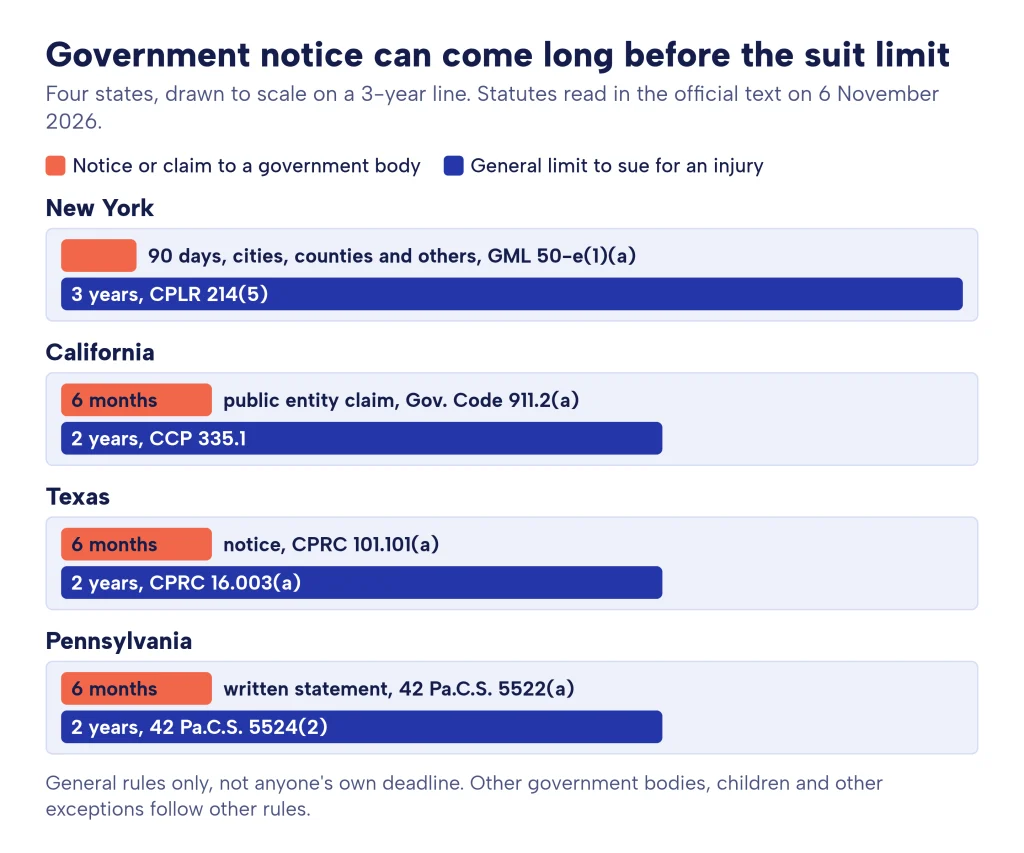
Two groups of rules change the answer more often than any other. If a city bus, a county road crew, a state agency, a public school or a federal employee was involved, a notice or claim can be due long before the lawsuit limit, sometimes in 90 days or 6 months, and in some states a late notice ends the claim. And if the injured person is a child, many states pause the clock, but not all of them in the same way, and some set an outer limit.
The table covers the rules we read. Many states have more than one government rule (for the state, for counties, for cities, for road defects), and some cities set their own periods in their charters. A row that covers only some bodies says so. For a child’s claim, our page on settlements for minors explains the court approval side.
| State | Government notice or claim |
|---|---|
| Alabama | Cities: 6 months* |
| Alaska | No state notice period* |
| Arizona | 180 days* |
| Arkansas | – |
| California | 6 months* |
| Colorado | – |
| Connecticut | Roads: 90 days* |
| Delaware | –* |
| District of Columbia | 6 months |
| Florida | 3 years* |
| Georgia | – |
| Hawaii | 2 years* |
| Idaho | 180 days* |
| Illinois | 1 year* |
| Indiana | – |
| Iowa | 2 years* |
| Kansas | No fixed deadline* |
| Kentucky | City streets: 90 days* |
| Louisiana | – |
| Maine | 365 days* |
| Maryland | 1 year* |
| Massachusetts | 2 years* |
| Michigan | 6 months* |
| Minnesota | 180 days* |
| Mississippi | – |
| Missouri | Streets: 90 days* |
| Montana | No deadline in text* |
| Nebraska | 1 year* |
| Nevada | 2 years |
| New Hampshire | – |
| New Jersey | – |
| New Mexico | –* |
| New York | 90 days* |
| North Carolina | State: 3 years* |
| North Dakota | 180 days* |
| Ohio | Suit: 2 years* |
| Oklahoma | 1 year |
| Oregon | 180 days* |
| Pennsylvania | 6 months* |
| Rhode Island | Suit: 3 years* |
| South Carolina | Suit: 2 years* |
| South Dakota | 180 days |
| Tennessee | – |
| Texas | 6 months* |
| Utah | 1 year* |
| Vermont | – |
| Virginia | 6 months* |
| Washington | Claim first* |
| West Virginia | Suit: 2 years* |
| Wisconsin | – |
| Wyoming | 2 years* |
Each state in full
Tap a state to open its full rules: injury, wrongful death and property limits, the government notice and claim rules, the rule for a child’s own claim, the statute sections, and the date we read them.
Alabama: injury 2 years · death 2 years
- Injury to a person: 2 years, “any injury to the person or rights of another not arising from contract”, Code 6-2-38(l)
- Wrongful death: 2 years from death, 6-2-38(a), 6-5-410(d)
- Damage to a car or other property: Not confirmed: the text doesn’t settle whether a crash falls under 2 years (6-2-38(l)) or 6 years (6-2-34)
- Claims against a government: Cities: claims presented within 6 months, 11-47-23, with a sworn statement, 11-47-192. Counties and state: not confirmed
- A child’s own claim: Under 19: 3 years (or the normal period, if shorter) after the disability ends; 20-year outer limit, 6-2-8(a)
- Read: 6 Nov 2026, in the main statute read
Alaska: injury 2 years · death 2 years
- Injury to a person: 2 years, AS 09.10.070(a)(2)
- Wrongful death: 2 years after death, 09.55.580(a)
- Damage to a car or other property: 2 years, 09.10.070(a)(3)
- Claims against a government: No notice period in 09.50.250 (state). Local rules: not confirmed
- A child’s own claim: Not counted, but no extension more than 2 years after the disability ends, 09.10.140(a)
- Read: 6 Nov 2026, in the main statute read
Arizona: injury 2 years · death 2 years
- Injury to a person: 2 years, ARS 12-542(1)
- Wrongful death: 2 years, counted from the death, 12-542(2)
- Damage to a car or other property: 2 years, 12-542(3) to (5)
- Claims against a government: Claim within 180 days, with the facts and a specific amount for which it can be settled, or barred, 12-821.01(A); suit within 1 year, 12-821
- A child’s own claim: Time under 18 not counted, 12-502. Government claims: 180 days after the disability ends, 12-821.01(D)
- Read: 6 Nov 2026, in the main statute read
Arkansas: injury not confirmed · death not confirmed
- Injury to a person: Not confirmed. Ask the state’s courts.
- Wrongful death: Not confirmed. Ask the state’s courts.
- Damage to a car or other property: Not confirmed. Ask the state’s courts.
- Claims against a government: Not confirmed. Ask the state’s courts.
- A child’s own claim: Not confirmed. Ask the state’s courts.
- Read: 6 Nov 2026
California: injury 2 years · death 2 years
- Injury to a person: 2 years, CCP 335.1
- Wrongful death: 2 years, CCP 335.1
- Damage to a car or other property: 3 years, “injuring goods or chattels”, CCP 338(c)(1)
- Claims against a government: Claim within 6 months for death, injury to a person or personal property, Gov. Code 911.2(a); late-claim application within a reasonable time, not over 1 year, 911.4; suit within 6 months of a written rejection, otherwise 2 years from accrual, 945.6
- A child’s own claim: Not counted, CCP 352(a), but not for claims that must first be presented to a public entity, 352(b)
- Read: 6 Nov 2026, in the main statute read
Colorado: injury not confirmed · death not confirmed
- Injury to a person: Not confirmed: only a 2024 compilation read, and a separate motor vehicle rule (13-80-101) not read
- Wrongful death: Not confirmed. Ask the state’s courts.
- Damage to a car or other property: Not confirmed. Ask the state’s courts.
- Claims against a government: Not confirmed. Ask the state’s courts.
- A child’s own claim: Not confirmed. Ask the state’s courts.
- Read: 6 Nov 2026
Connecticut: injury 2 years · death 2 years
- Injury to a person: 2 years from the injury, or from when it was or should have been discovered, never more than 3 years from the act, C.G.S. 52-584
- Wrongful death: 2 years from death, never more than 5 years from the act, 52-555(a)
- Damage to a car or other property: 2 years, same terms, 52-584
- Claims against a government: Road or bridge defects: written notice within 90 days to the town, city or borough clerk; suit within 2 years, 13a-149. Other claims: not confirmed
- A child’s own claim: Not confirmed: no general minors’ section found in chapter 926
- Read: 6 Nov 2026, in the main statute read
Delaware: injury 2 years · death 2 years
- Injury to a person: 2 years, 10 Del. C. 8119
- Wrongful death: 2 years, 8107
- Damage to a car or other property: 2 years, 8107
- Claims against a government: No notice section in the county and municipal sections read, 4010 to 4013. State claims: not confirmed
- A child’s own claim: Not confirmed: 8116 on its face doesn’t cover 8119
- Read: 6 Nov 2026, in the main statute read
District of Columbia: injury 1 or 3 years · death 2 years
- Injury to a person: No personal injury paragraph in D.C. Code 12-301. The catch-all, (8), gives 3 years for claims with no other limit; assault, battery, “wounding” and similar claims have 1 year, (4). Which paragraph covers a claim is for the court
- Wrongful death: 2 years after death, 16-2702
- Damage to a car or other property: 3 years, 12-301(3)
- Claims against a government: Written notice to the Mayor within 6 months; a police report can count, 12-309(a)
- A child’s own claim: Within the time limited after the disability is removed (under 18), 12-302(a)
- Read: 6 Nov 2026, in the main statute read
Florida: injury 2 years · death 2 years
- Injury to a person: 2 years for negligence, Fla. Stat. 95.11(5)(a), for claims that arose after 24 March 2023 (Laws of Fla. ch. 2023-15). Earlier injuries: an earlier limit, not confirmed
- Wrongful death: 2 years, 95.11(5)(e); against a person for murder or manslaughter: any time, 95.11(11)
- Damage to a car or other property: Not confirmed: 4 years for “injuring personal property” (95.11(3)(g)) or 2 years for negligence (95.11(5)(a)); the text doesn’t settle which
- Claims against a government: Written claim within 3 years (wrongful death claim to the Department of Financial Services within 2), 768.28(6)(a); suit within 4 years, except wrongful death and malpractice, 768.28(14)
- A child’s own claim: Paused only while there is no parent or guardian, or one with an adverse interest or incapacity; 7-year outer limit; not for malpractice, 95.051(1)(i)
- Read: 6 Nov 2026, in the main statute read
Georgia: injury not confirmed · death not confirmed
- Injury to a person: Not confirmed: only a court opinion read
- Wrongful death: Not confirmed. Ask the state’s courts.
- Damage to a car or other property: Not confirmed. Ask the state’s courts.
- Claims against a government: Not confirmed. Ask the state’s courts.
- A child’s own claim: Not confirmed. Ask the state’s courts.
- Read: 6 Nov 2026
Hawaii: injury 2 years · death 2 years
- Injury to a person: 2 years, “damage or injury to persons or property”, HRS 657-7
- Wrongful death: 2 years from the date of death, “except as otherwise provided”, 663-3(b)
- Damage to a car or other property: 2 years, 657-7
- Claims against a government: Counties: written notice within 2 years, 46-72. State: suit within 2 years, 662-4
- A child’s own claim: Within the times limited after the disability is removed, “or at any time while the disability exists”, 657-13
- Read: 6 Nov 2026, in the main statute read
Idaho: injury 2 years · death 2 years
- Injury to a person: 2 years, Idaho Code 5-219(4)
- Wrongful death: 2 years, 5-219(4)
- Damage to a car or other property: Not confirmed
- Claims against a government: Claim within 180 days of the claim arising or reasonable discovery (state 6-905, local 6-906); suit within 2 years, 6-911
- A child’s own claim: Not counted, but no tolling for more than 6 years, 5-230
- Read: 6 Nov 2026, in the main statute read
Illinois: injury 2 years · death 2 years
- Injury to a person: 2 years, 735 ILCS 5/13-202
- Wrongful death: 2 years from death, 740 ILCS 180/2(d); longer against the person responsible for some violent intentional acts or charged crimes, 180/2(e)
- Damage to a car or other property: 5 years, 735 ILCS 5/13-205
- Claims against a government: Local public entities: suit within 1 year, 745 ILCS 10/8-101(a). State: notice within 1 year to the Attorney General and the Court of Claims clerk, 705 ILCS 505/22-1
- A child’s own claim: 2 years after turning 18, 735 ILCS 5/13-211(a)
- Read: 6 Nov 2026, in the main statute read
Indiana: injury not confirmed · death not confirmed
- Injury to a person: Not confirmed. Ask the state’s courts.
- Wrongful death: Not confirmed. Ask the state’s courts.
- Damage to a car or other property: Not confirmed. Ask the state’s courts.
- Claims against a government: Not confirmed. Ask the state’s courts.
- A child’s own claim: Not confirmed. Ask the state’s courts.
- Read: 6 Nov 2026
Iowa: injury 2 years · death not confirmed
- Injury to a person: 2 years, Iowa Code 614.1(2)
- Wrongful death: Not confirmed
- Damage to a car or other property: 5 years, “injuries to property”, 614.1(4)
- Claims against a government: Cities and other municipalities: suit within 2 years, 670.5. State: written claim within 2 years, 669.13
- A child’s own claim: 1 year after reaching majority, 614.8(2)
- Read: 6 Nov 2026, in the main statute read
Kansas: injury 2 years · death 2 years
- Injury to a person: 2 years, K.S.A. 60-513(a)(4)
- Wrongful death: 2 years, 60-513(a)(5)
- Damage to a car or other property: 2 years, 60-513(a)(2)
- Claims against a government: Municipalities: written notice before suit; no suit until denial or 120 days, 12-105b(d). No fixed notice deadline in the text read
- A child’s own claim: 1 year after the disability is removed, never more than 8 years after the act, 60-515(a)
- Read: 6 Nov 2026, in the main statute read
Kentucky: injury 1 or 2 years · death not confirmed
- Injury to a person: Two rules: 1 year for “an injury to the person”, KRS 413.140(1)(a); tort suits under the Motor Vehicle Reparations Act: 2 years after the injury, the death or the last no-fault (reparation) payment, whichever is later, 304.39-230(6). Which applies is for the court
- Wrongful death: Not confirmed
- Damage to a car or other property: Not confirmed
- Claims against a government: City street, sidewalk or bridge defects: notice within 90 days to the mayor or clerk, 411.110. Others: not confirmed
- A child’s own claim: The same number of years after the disability ends, 413.170(1)
- Read: 6 Nov 2026, in the main statute read
Louisiana: injury 2 years · death 1 or 2 years
- Injury to a person: 2 years, Civil Code art. 3493.1, for claims arising after 1 July 2024 (Act 423 of 2024). Earlier claims: not confirmed
- Wrongful death: 1 year from the death or 2 years from the injury, whichever is longer, art. 2315.2(B); malpractice: 1 year from the death, (F). This is the text as amended by Act 176 of 2025, effective 1 August 2025; the act doesn’t say how it applies to earlier deaths, so for those it is not confirmed
- Damage to a car or other property: 2 years, art. 3493.1, same date rule
- Claims against a government: Not confirmed. Ask the state’s courts.
- A child’s own claim: Not confirmed (3493.1 mentions minors only for some product claims)
- Read: 6 Nov 2026, in the main statute read
Maine: injury 6 years · death 3 years
- Injury to a person: 6 years, 14 M.R.S. 752 (the general rule for civil actions)
- Wrongful death: 3 years after death (homicide: 6 years from discovery), 18-C M.R.S. 2-807
- Damage to a car or other property: 6 years, 752
- Claims against a government: Written notice within 365 days (later for good cause), 14 M.R.S. 8107(1); suit within 2 years, 8110
- A child’s own claim: Within the times limited after the disability is removed, 853; government claims: 2 years after turning 18, 8110
- Read: 6 Nov 2026, in the main statute read
Maryland: injury 3 years · death 3 years
- Injury to a person: 3 years, Cts. & Jud. Proc. 5-101
- Wrongful death: 3 years after death, 3-904(g)(1)
- Damage to a car or other property: 3 years, 5-101
- Claims against a government: Local government: written notice within 1 year, 5-304(b), with exceptions in (d) and (e). State: claim to the Treasurer within 1 year, suit within 3 years, State Gov’t 12-106
- A child’s own claim: The lesser of 3 years or the normal period after the disability ends, 5-201(a)
- Read: 6 Nov 2026, in the main statute read
Massachusetts: injury 3 years · death 3 years
- Injury to a person: 3 years, M.G.L. c. 260 s. 2A
- Wrongful death: 3 years from death or discovery, c. 229 s. 2
- Damage to a car or other property: 3 years, c. 260 s. 2A
- Claims against a government: Public employers: written presentment within 2 years, suit within 3 years, c. 258 s. 4. Road defects: notice within 30 days, c. 84 s. 18
- A child’s own claim: Within the time limited after the disability is removed, c. 260 s. 7
- Read: 6 Nov 2026, in the main statute read
Michigan: injury 3 years · death 3 years
- Injury to a person: 3 years, MCL 600.5805(2)
- Wrongful death: 3 years, 600.5805(2)
- Damage to a car or other property: 3 years, 600.5805(2)
- Claims against a government: State: written claim or notice in the Court of Claims within 6 months for injury or property damage, 600.6431(4). Highway defects: 120 days (180 if under 18), 691.1404
- A child’s own claim: 1 year after the disability ends, 600.5851(1)
- Read: 6 Nov 2026, in the main statute read
Minnesota: injury 6 or 2 years · death 3 years
- Injury to a person: Two texts: 6 years for “any other injury to the person or rights of another, not arising on contract, and not hereinafter enumerated”, Minn. Stat. 541.05 subd. 1(5); 2 years for “libel, slander, assault, battery, false imprisonment, or other tort resulting in personal injury”, 541.07(1). Which covers a claim is for the court
- Wrongful death: 3 years after death, and within 6 years of the act (murder: any time), 573.02
- Damage to a car or other property: 6 years, 541.05
- Claims against a government: Cities and other municipalities: notice within 180 days of discovery, 466.05. State: notice to the Attorney General within 180 days, 3.736 subd. 5
- A child’s own claim: “such period, except in the case of infancy, shall not be extended for more than five years, nor in any case for more than one year after the disability ceases”, 541.15(a)
- Read: 6 Nov 2026, in the main statute read
Mississippi: injury not confirmed · death not confirmed
- Injury to a person: Not confirmed. Ask the state’s courts.
- Wrongful death: Not confirmed. Ask the state’s courts.
- Damage to a car or other property: Not confirmed. Ask the state’s courts.
- Claims against a government: Not confirmed. Ask the state’s courts.
- A child’s own claim: Not confirmed. Ask the state’s courts.
- Read: 6 Nov 2026
Missouri: injury 5 years · death 3 years
- Injury to a person: 5 years, RSMo 516.120(4)
- Wrongful death: 3 years, 537.100
- Damage to a car or other property: 5 years, “injuring any goods or chattels”, 516.120(4)
- Claims against a government: Street and sidewalk defects: written notice within 90 days to the mayor in cities of 100,000 or more and in third- and fourth-class cities, 82.210, 77.600, 79.480
- A child’s own claim: The text speaks of a person “within the age of twenty-one years”, 516.170. Ask the court how it applies
- Read: 6 Nov 2026, in the main statute read
Montana: injury 3 years · death 3 years
- Injury to a person: 3 years, MCA 27-2-204(1)
- Wrongful death: 3 years (homicide: 10 years), 27-2-204(2)
- Damage to a car or other property: Not confirmed
- Claims against a government: State claims go to the Department of Administration; no suit until denied, deemed denied after 120 days, 2-9-301. No deadline in that section
- A child’s own claim: Time of minority not counted, 27-2-401(1)
- Read: 6 Nov 2026, in the main statute read
Nebraska: injury 4 years · death 2 years
- Injury to a person: 4 years, Neb. Rev. Stat. 25-207(3)
- Wrongful death: 2 years after death, 30-810
- Damage to a car or other property: 4 years, 25-207(2)
- Claims against a government: Political subdivisions: written claim within 1 year, suit within 2 years, 13-919(1). State: written claim within 2 years, 81-8,227
- A child’s own claim: The text speaks of a person “within the age of twenty years”, 25-213. Ask the court how it applies
- Read: 6 Nov 2026, in the main statute read
Nevada: injury 2 years · death 2 years
- Injury to a person: 2 years, NRS 11.190(4)(e)
- Wrongful death: 2 years, 11.190(4)(e)
- Damage to a car or other property: 3 years, 11.190(3)(c)
- Claims against a government: Claim within 2 years: state claims with the Attorney General, political subdivisions with their governing body, 41.036
- A child’s own claim: Time under 18 not counted, 11.250
- Read: 6 Nov 2026, in the main statute read
New Hampshire: injury not confirmed · death not confirmed
- Injury to a person: Not confirmed. Ask the state’s courts.
- Wrongful death: Not confirmed. Ask the state’s courts.
- Damage to a car or other property: Not confirmed. Ask the state’s courts.
- Claims against a government: Not confirmed. Ask the state’s courts.
- A child’s own claim: Not confirmed. Ask the state’s courts.
- Read: 6 Nov 2026
New Jersey: injury 2 years · death not confirmed
- Injury to a person: 2 years, N.J.S.A. 2A:14-2(a); birth injuries in medical malpractice: before the child’s 13th birthday, same section
- Wrongful death: Not confirmed. Ask the state’s courts.
- Damage to a car or other property: Not confirmed. Ask the state’s courts.
- Claims against a government: Not confirmed: only a court opinion read
- A child’s own claim: Not confirmed. Ask the state’s courts.
- Read: 6 Nov 2026, in the main statute read
New Mexico: injury 3 years · death not confirmed
- Injury to a person: 3 years, NMSA 37-1-8
- Wrongful death: Not confirmed: the wrongful death section, 41-2-2, could not be re-read in the official text
- Damage to a car or other property: 4 years, “injuries to property”, 37-1-4
- Claims against a government: Not confirmed: the Tort Claims Act, 41-4-15 and 41-4-16, could not be re-read in the official text. Ask the state’s courts; a notice may be due within months
- A child’s own claim: Extended so that a minor has 1 year after the incapacity ends, 37-1-10. Whether that reaches claims against the state or a local public body is not confirmed
- Read: 6 Nov 2026, in the main statute read
New York: injury 3 years · death 2 years
- Injury to a person: 3 years, CPLR 214(5)
- Wrongful death: 2 years from death, EPTL 5-4.1
- Damage to a car or other property: 3 years, CPLR 214(4)
- Claims against a government: Cities, counties, towns, villages, school and fire districts: notice of claim within 90 days (wrongful death: 90 days from the appointment of the estate’s representative), General Municipal Law 50-e(1)(a); suit within 1 year and 90 days (wrongful death: 2 years after the death), 50-i. State: claim or notice of intention within 90 days, Court of Claims Act 10(3); wrongful death: claim within 90 days of the executor’s or administrator’s appointment unless a notice of intention is served, and in any event within 2 years of the death, 10(2)
- A child’s own claim: If the normal period is 3 years or more, 3 years after the disability ends; 10-year outer limit, except for infants outside medical, dental and podiatric malpractice, CPLR 208(a)
- Read: 6 Nov 2026, in the main statute read
North Carolina: injury 3 years · death 2 years
- Injury to a person: 3 years, G.S. 1-52(16), counted from when bodily harm becomes apparent; with listed exceptions, no claim accrues more than 10 years after the defendant’s last act
- Wrongful death: 2 years, counted from the death, 1-53(4); no death claim if the injured person’s own claim was already barred under 1-52(16) or the malpractice section, 1-15(c)
- Damage to a car or other property: 3 years, 1-52(16)
- Claims against a government: State: claim with the Industrial Commission within 3 years (wrongful death: 2 years), 143-299. Local: not confirmed
- A child’s own claim: Within the time limited after the disability is removed (under 18), 1-17(a); malpractice rules in (b) and (c)
- Read: 6 Nov 2026, in the main statute read
North Dakota: injury 6 years · death 2 years
- Injury to a person: 6 years, NDCC 28-01-16(5); assault, battery and similar: 2 years, 28-01-18(1)
- Wrongful death: 2 years from death, 28-01-18(4)
- Damage to a car or other property: 6 years, 28-01-16(4)
- Claims against a government: State: written notice within 180 days of discovery (1 year for a serious injury), 32-12.2-04(1). Political subdivisions: suit within 3 years, 32-12.1-10
- A child’s own claim: No extension over 5 years except for infancy, nor over 1 year after the disability ends; malpractice capped at 12 years, 28-01-25
- Read: 6 Nov 2026, in the main statute read
Ohio: injury 2 years · death 2 years
- Injury to a person: 2 years, R.C. 2305.10(A)
- Wrongful death: 2 years after death, 2125.02(F)(1)
- Damage to a car or other property: 2 years, 2305.10(A)
- Claims against a government: Political subdivisions: suit within 2 years, 2744.04(A); Court of Claims: 2 years, 2743.16. No notice section
- A child’s own claim: Within the normal period after the disability is removed, 2305.16
- Read: 6 Nov 2026, in the main statute read
Oklahoma: injury 2 years · death 2 years
- Injury to a person: 2 years, 12 O.S. 95(A)(3)
- Wrongful death: 2 years, 12 O.S. 1053
- Damage to a car or other property: 2 years, 95(A)(3)
- Claims against a government: State and political subdivisions: written claim within 1 year of the loss, or barred, 51 O.S. 156(B)
- A child’s own claim: 1 year after the disability is removed (malpractice has its own rules), 12 O.S. 96
- Read: 6 Nov 2026, in the main statute read
Oregon: injury 2 years · death 3 years
- Injury to a person: 2 years, ORS 12.110(1)
- Wrongful death: 3 years after the injury causing the death is discovered or reasonably should have been, but never later than the earliest of 3 years after the death or any other period that applies to the act, ORS 30.020(1)
- Damage to a car or other property: Not confirmed
- Claims against a government: Notice within 180 days; wrongful death: 1 year; up to 90 days of incapacity or minority excluded; actual notice, a suit within the period or payment also count, 30.275
- A child’s own claim: Paused while under 18, but not more than 5 years, or more than 1 year after turning 18, whichever comes first, 12.160
- Read: 6 Nov 2026, in the main statute read
Pennsylvania: injury 2 years · death 2 years
- Injury to a person: 2 years, 42 Pa.C.S. 5524(2)
- Wrongful death: 2 years, 5524(2)
- Damage to a car or other property: 2 years, 5524(3)
- Claims against a government: Written statement within 6 months to the government unit (and to the Attorney General for a Commonwealth agency), 5522(a)
- A child’s own claim: Minority not counted; the same time after turning 18, 5533(b)(1)
- Read: 6 Nov 2026, in the main statute read
Rhode Island: injury 3 years · death 3 years
- Injury to a person: 3 years, R.I. Gen. Laws 9-1-14(b)
- Wrongful death: 3 years after death, 10-7-2
- Damage to a car or other property: Not confirmed
- Claims against a government: Suit within 3 years against the state, cities and towns, 9-1-25(a). Highway or bridge defects: notice within 60 days, 45-15-9(a)
- A child’s own claim: Within the time limited after the impediment is removed (under 18), 9-1-19
- Read: 6 Nov 2026, in the main statute read
South Carolina: injury 3 years · death 3 years
- Injury to a person: 3 years, S.C. Code 15-3-530(5)
- Wrongful death: 3 years, counted from the death, 15-3-530(6)
- Damage to a car or other property: 3 years, 15-3-530(4)
- Claims against a government: Tort Claims Act: suit within 2 years of discovery, or 3 years if a verified claim was filed first (the claim is optional), 15-78-110, 15-78-80(a)
- A child’s own claim: No extension over 5 years except for infancy, nor over 1 year after the disability ends; applies to Tort Claims Act suits too, 15-3-40
- Read: 6 Nov 2026, in the main statute read
South Dakota: injury 3 years · death 3 years
- Injury to a person: 3 years, SDCL 15-2-14(3)
- Wrongful death: 3 years after death, 21-5-3
- Damage to a car or other property: 6 years, 15-2-13(4)
- Claims against a government: Written notice within 180 days to the public entity, 3-21-2, 3-21-3
- A child’s own claim: No extension over 5 years except for infancy, nor over 1 year after the disability ends, 15-2-22
- Read: 6 Nov 2026, in the main statute read
Tennessee: injury not confirmed · death not confirmed
- Injury to a person: Not confirmed: only court opinions read
- Wrongful death: Not confirmed. Ask the state’s courts.
- Damage to a car or other property: Not confirmed. Ask the state’s courts.
- Claims against a government: Not confirmed. Ask the state’s courts.
- A child’s own claim: Not confirmed. Ask the state’s courts.
- Read: 6 Nov 2026
Texas: injury 2 years · death 2 years
- Injury to a person: 2 years, Civ. Prac. & Rem. Code 16.003(a)
- Wrongful death: 2 years from death, 16.003(b)
- Damage to a car or other property: 2 years, 16.003(a)
- Claims against a government: Notice within 6 months describing the injury, time, place and incident, 101.101(a); city charter periods can apply, 101.101(b) (charters not read); actual notice exception, (c)
- A child’s own claim: Time under 18 not counted, 16.001
- Read: 6 Nov 2026, in the main statute read
Utah: injury not confirmed · death 2 years
- Injury to a person: Not confirmed: no injury paragraph found; the 4-year catch-all, 78B-2-307(4), was read, but which limit governs is case law
- Wrongful death: 2 years, 78B-2-304(3)
- Damage to a car or other property: 4 years for motor vehicle property damage from an accident, 78B-2-307(3)
- Claims against a government: Notice of claim within 1 year after the claim arises, 63G-7-402; the clock waits until the claimant knew or should have known, 63G-7-401(2)
- A child’s own claim: The limit “may not run” while under 18, 78B-2-108(2)
- Read: 6 Nov 2026, in the main statute read
Vermont: injury 3 years · death 2 years
- Injury to a person: 3 years, counted from discovery of the injury, 12 V.S.A. 512(4)
- Wrongful death: 2 years from discovery of the death (7 years where a homicide charge is probable), 14 V.S.A. 1492(a)
- Damage to a car or other property: 3 years, 12 V.S.A. 512(5)
- Claims against a government: No notice section read. Not confirmed
- A child’s own claim: Within the times limited after the disability is removed, 12 V.S.A. 551(a)
- Read: 6 Nov 2026, in the main statute read
Virginia: injury 2 years · death 2 years
- Injury to a person: 2 years, Code 8.01-243(A)
- Wrongful death: 2 years after death, 8.01-244(B)
- Damage to a car or other property: 5 years, 8.01-243(B)
- Claims against a government: Counties, cities and towns: written statement within 6 months, 15.2-209. The Commonwealth: 1 year, 8.01-195.6
- A child’s own claim: Within the prescribed period after the disability is removed, 8.01-229(A)(1); malpractice: 8.01-243.1
- Read: 6 Nov 2026, in the main statute read
Washington: injury 3 years · death not confirmed
- Injury to a person: 3 years, RCW 4.16.080(2)
- Wrongful death: Not confirmed
- Damage to a car or other property: 3 years, 4.16.080(2)
- Claims against a government: Local: claim to the appointed agent on the standard form within the limitation period, 4.96.020. State: claim to the office of risk management; no suit for 60 days, and the limit pauses for those 60 days, 4.92.100, 4.92.110
- A child’s own claim: Time under 18 not counted, 4.16.190(1)
- Read: 6 Nov 2026, in the main statute read
West Virginia: injury 2 years · death 2 years
- Injury to a person: 2 years, W. Va. Code 55-2-12(b)
- Wrongful death: 2 years after death, 55-7-6(d)
- Damage to a car or other property: 2 years, 55-2-12(a)
- Claims against a government: Political subdivisions: suit within 2 years; under 10 years old, 2 years or before the 12th birthday, whichever is longer, 29-12A-6. No notice section
- A child’s own claim: The same number of years after reaching full age, never more than 20 years after the claim arose, 55-2-15(b)
- Read: 6 Nov 2026, in the main statute read
Wisconsin: injury not confirmed · death not confirmed
- Injury to a person: Not confirmed. Ask the state’s courts.
- Wrongful death: Not confirmed. Ask the state’s courts.
- Damage to a car or other property: Not confirmed. Ask the state’s courts.
- Claims against a government: Not confirmed. Ask the state’s courts.
- A child’s own claim: Not confirmed. Ask the state’s courts.
- Read: 6 Nov 2026
Wyoming: injury 4 years · death 2 years
- Injury to a person: 4 years, Wyo. Stat. 1-3-105(a)(iv)(C)
- Wrongful death: 2 years after death, 1-38-102(d)
- Damage to a car or other property: 4 years, 1-3-105(a)(iv)(B)
- Claims against a government: Itemized written claim within 2 years of the act (discovery exception); a child 7 or younger: 2 years or until the 8th birthday, whichever is greater, 1-39-113(a)
- A child’s own claim: 3 years after the disability is removed, or the normal period if longer, 1-3-114
- Read: 6 Nov 2026, in the main statute read
Federal agencies: written claim within 2 years
- Claims against a government: Written claim to the agency within 2 years; suit within 6 months after the agency mails a final denial, 28 U.S.C. 2401(b)
- A child’s own claim: Not covered here
- Read: 6 Nov 2026
What else can change the time
The general rule is where the count starts, not where it ends. These are the exceptions we saw most often in the texts we read.
Medical malpractice has its own, often shorter, limit
An injury caused by a doctor, hospital or other health care provider is usually under a separate section. A few we read:
- Ohio: 1 year, R.C. 2305.113, beside a 2-year general limit. A written notice before the year runs out can extend it, 2305.113(B).
- Kentucky: actions against a physician, surgeon, dentist or licensed hospital for negligence or malpractice sit inside the 1-year section, KRS 413.140(1)(e), counted from when the injury was or should have been discovered, but within 5 years of the act, 413.140(2).
- California: 3 years from the injury or 1 year from discovery, whichever comes first, with a 3-year ceiling except for fraud, concealment or a foreign body, CCP 340.5.
- Florida: 2 years from the incident or its discovery, and no more than 4 years from the incident, with exceptions for fraud and for young children, Fla. Stat. 95.11(5)(c).
- Texas: 2 years from the breach or the end of treatment, with a 10-year outer limit; a child under 12 has until the 14th birthday, and otherwise the section applies regardless of age, CPRC 74.251.
When the injury was found later
Some statutes count from when the injury was discovered or should have been: Connecticut (52-584, with a 3-year outer limit from the act), Vermont (12 V.S.A. 512(4)), and Kansas, where the time starts when the act first causes substantial injury, or later if the injury isn’t reasonably ascertainable, but never more than 10 years after the act (K.S.A. 60-513(b)). North Carolina counts from when bodily harm becomes apparent, but with listed exceptions no claim accrues more than 10 years after the last act (G.S. 1-52(16)). Courts sometimes apply a discovery rule where the statute is silent. Whether one applies to a particular injury is a question for a lawyer or the court.
When someone has died
A wrongful death claim usually has its own limit, and many statutes count it from the death rather than the injury. Some add an outer limit counted from the act: Connecticut 5 years (52-555(a)), Minnesota 6 years (573.02). Louisiana uses whichever is longer of 1 year from the death or 2 years from the injury (Civil Code art. 2315.2(B), as amended by Act 176 of 2025, effective 1 August 2025; how it applies to earlier deaths is not confirmed). In North Carolina, no death claim may be brought if the injured person’s own claim was already barred when they died under the general injury rule or the malpractice rule (G.S. 1-53(4), 1-52(16), 1-15(c)). The claims the injured person had before dying can be a separate claim with separate rules. Our pages on wrongful death deadlines and wrongful death and survival actions go into both.
No-fault benefits and car claims
A claim for your own no-fault (personal injury protection) benefits can run on a different clock from a lawsuit against the other driver. In Michigan, a suit for no-fault benefits is generally due 1 year after the accident unless notice was given or benefits were paid, with further rules after that (MCL 500.3145). Kentucky’s motor vehicle act sets its own periods for benefits and for tort suits, including 2 years after the last no-fault payment (KRS 304.39-230). Fault rules are separate again: see our state-by-state fault rule lookup.
Other things that pause or shorten the clock
- A defendant who left the state. Some texts stop the count while the person sued is absent, for example Missouri’s wrongful death section (RSMo 537.100), Vermont’s (14 V.S.A. 1492(a)) and New Mexico’s general rule (NMSA 37-1-9).
- Product claims. Florida’s statute has a separate 4-year paragraph for an injury founded on the design, manufacture, distribution or sale of personal property (95.11(3)(d)). Which paragraph covers a claim is for the court.
- Assault and similar claims. Some states set a shorter period: 1 year in DC (12-301(4)) and Wyoming (1-3-105(a)(v)(B)), 2 years in Michigan (MCL 600.5805(3)), Minnesota (541.07(1)) and North Dakota (28-01-18(1)).
- A change in the law. Florida (2023) and Louisiana (2024) changed their limits for new claims only. Which version applies depends on when the claim arose.
The statutes we read set a time to bring a lawsuit (“commenced”, “brought”). Calling or writing to an insurer is not a lawsuit. Don’t assume that talks with an insurer pause the count; ask the court or a lawyer.
Figures you may see elsewhere
You may see the claims below on other pages. We checked each against the statute.
- “You have two years to sue.” Not as a national rule. The general injury limits we read run from 1 year (Kentucky’s 413.140) to 6 years (Maine, North Dakota), and government notice can be due in months.
- “Florida gives you four years.” Out of date for negligence claims that arose after 24 March 2023: the limit is 2 years (95.11(5)(a)).
- “Louisiana gives you one year.” Out of date for claims arising after 1 July 2024: Article 3493.1 gives 2 years.
- “Children can always wait until 18.” No. Florida pauses the clock only when no parent or guardian can act (95.051(1)(i)), several states cap the pause, and California’s pause doesn’t apply to claims that must first go to a public entity (CCP 352(b)).
A worked example
This page is general information, not legal, tax or medical advice, and not a substitute for the advice of an attorney. Injury law and deadlines vary by state and change. Ask a lawyer or the court about your situation.
This is a made-up example, matching the calculator’s starting values. Someone is hurt in a crash in Texas on 15 March 2026.
- The calculator shows 2 years, from Texas Civil Practice and Remedies Code 16.003(a): suit “not later than two years after the day the cause of action accrues”.
- The arithmetic shows 15 March 2028. That is the same date two years on, nothing more.
- Now change one fact. If the other vehicle belonged to a city, the Texas Tort Claims Act requires notice within 6 months describing the injury, the time, the place and the incident (CPRC 101.101(a)). Six months from 15 March 2026 is mid-September 2026, and a city’s charter can set its own notice period (101.101(b); we haven’t read the charters).
- Change another fact. If the injured person was 16, Texas doesn’t count time under 18 (16.001), so the 2 years don’t start on the crash date. The 6-month government notice in 101.101(a) has no such pause in its text.
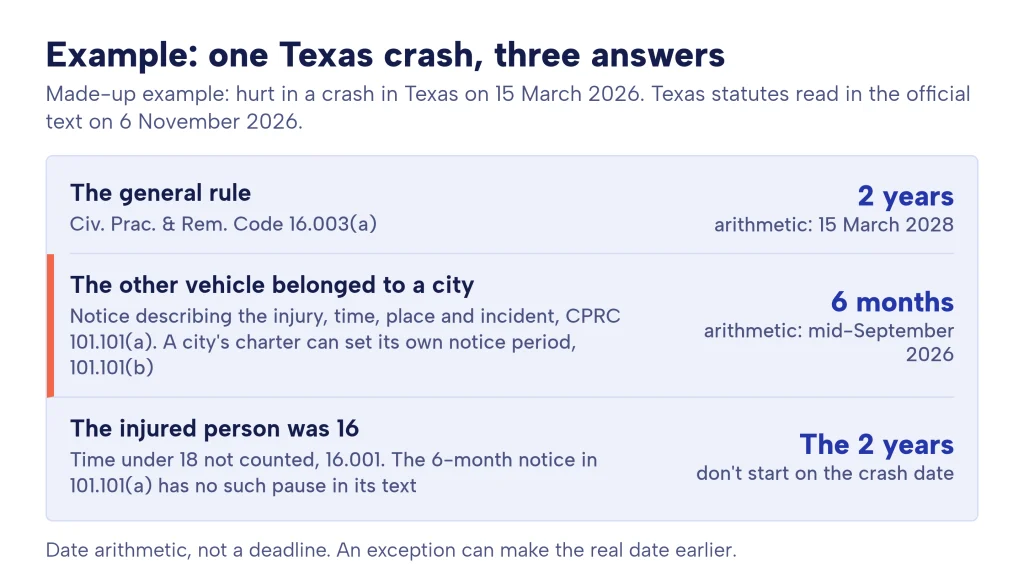
The same crash can have three different answers. That is why the calculator gives the general rule and stops there. Our Texas page covers that state in full, and there are separate pages for New York after its May 2026 change and for California.
How these rows were read
Each row comes from the state legislature’s or code publisher’s official website, read on 6 November 2026. Illinois links go to the General Assembly site. New Mexico was read at NMOneSource, published by the state’s Compilation Commission. Federal law was read in the Cornell Legal Information Institute’s copy of the US Code. We don’t take figures from law firm pages or form sites.
We could not read the official code for Arkansas, Georgia, Indiana, Mississippi, New Hampshire, Tennessee or Wisconsin: the sites refused us, or the official text sits behind a commercial publisher’s terms page. Colorado was read only in a 2024 compilation, and the texts for Minnesota and Utah don’t settle which limit covers an injury. Those rows say “not confirmed”. That doesn’t mean there is no limit. It means you need the court or a lawyer for that state.
Legislatures change injury rules, as Florida, Louisiana and New York have in the last few years. We recheck every row every three months and after each state’s legislative session, and the read date sits beside each row.
What to do next
- Write down the dates now: the date of the injury, the date it was found if that was later, the date of any death, and the date any no-fault payment was made.
- Ask whether a government body is involved, as a driver, an owner of the road or building, or an employer. If so, find the notice rule today. It may be the shortest deadline of all.
- If the injured person is under 18, look at the children’s column and ask the court how the pause works in that state.
- Read the statute yourself. Each linked state name opens the official text.
- Ask someone who can look at the facts. A court clerk can explain where and how to file but can’t give legal advice. A lawyer, or legal aid if cost is a barrier, can say which limit applies to you.

Sources checked on 6 November 2026.
Formulas and sources
- State code (Washington, DC is 51): Arithmetic on the reader's own entries, no outside figure
- Injury to a person: years in the statute read: State statutes listed in the table on this page, each read in the official text on 6 Nov 2026
- Wrongful death: years in the statute read: State statutes listed in the table on this page, each read in the official text on 6 Nov 2026
- Damage to a car: years in the statute read: State statutes listed in the table on this page, each read in the official text on 6 Nov 2026
- Years in the general rule for the claim chosen: State statutes listed in the table on this page, each read in the official text on 6 Nov 2026
- Year of the same date that many years later: Arithmetic on the reader's own entries, no outside figure
- That year is a leap year (1) or not (0): Arithmetic on the reader's own entries, no outside figure
- Month of that date: Arithmetic on the reader's own entries, no outside figure
- Day of that date (29 February becomes 28 February in a non-leap year, the earlier day): Arithmetic on the reader's own entries, no outside figure
Sources
- 28 U.S.C. 2401, tort claims against the United States (Cornell LII copy)
- Code of Alabama 6-2-38
- Alaska Statutes 09.10.070
- Arizona Revised Statutes 12-542
- California Code of Civil Procedure 335.1
- Connecticut General Statutes chapter 926 (52-584)
- Delaware Code title 10, chapter 81
- D.C. Code 12-301
- Florida Statutes 95.11
- Laws of Florida ch. 2023-15
- Hawaii Revised Statutes 657-7
- Idaho Code 5-219
- 735 ILCS 5/13-202
- Iowa Code 614.1
- Kansas Statutes 60-513
- Kentucky Revised Statutes 413.140
- Kentucky Revised Statutes 304.39-230
- Louisiana Civil Code art. 3493.1
- Louisiana Civil Code art. 2315.2
- Louisiana Act 423 of 2024 (HB 315)
- Maine Revised Statutes title 14, section 752
- Maryland Courts and Judicial Proceedings 5-101
- Massachusetts General Laws c. 260 s. 2A
- Michigan Compiled Laws 600.5805
- Michigan Compiled Laws 500.3145
- Minnesota Statutes 541.05
- Missouri Revised Statutes 516.120
- Montana Code 27-2-204
- Nebraska Revised Statutes 25-207
- Nevada Revised Statutes chapter 11
- New Mexico Statutes chapter 37, 37-1-4, 37-1-8, 37-1-9, 37-1-10 (NMOneSource, official compilation, 2026 file)
- New Jersey Statutes 2A:14-2
- New York CPLR 214
- North Carolina G.S. 1-52
- North Dakota Century Code chapter 28-01
- Ohio Revised Code 2305.10
- Ohio Revised Code 2305.113
- Oklahoma Statutes title 12, section 95
- Oregon Revised Statutes chapter 12
- Oregon Revised Statutes chapter 30 (30.020)
- Pennsylvania Consolidated Statutes title 42, 5524
- Rhode Island General Laws 9-1-14
- South Carolina Code title 15, chapter 3
- South Dakota Codified Laws 15-2-14
- Texas Civil Practice and Remedies Code chapter 16
- Texas Civil Practice and Remedies Code chapter 74
- Texas Civil Practice and Remedies Code chapter 101
- Utah Code 78B-2-307
- Vermont Statutes title 12, section 512
- Virginia Code 8.01-243
- Revised Code of Washington 4.16.080
- West Virginia Code 55-2-12
- Wyoming Statutes title 1
- Hawaii Revised Statutes 663-3
- Louisiana Acts 2025, No. 176 (HB 291), enrolled text and Résumé Digest
- Illinois Local Governmental and Governmental Employees Tort Immunity Act, 745 ILCS 10/8-101
- New York General Municipal Law 50-e
- New York Court of Claims Act 10