Diminished value is the drop in a car’s market value after it has been damaged and repaired: the difference between what it was worth just before the crash and what it is worth now. The calculator works it out two ways from your numbers. The first is the “17(c) formula”: 10% of the value before, times a damage modifier, times a mileage modifier, as a federal court described it in 2021. The second is the market-value difference between your before and after-repair figures. Both are estimates. Neither says what a claim is worth or what an insurer has to pay.
This page is general information, not legal, tax or medical advice, and not a substitute for the advice of an attorney. Injury law and deadlines vary by state and change. Ask a lawyer or the court about your situation.
Part of our guides to car damage, totaled cars and lost value. Below we show each step of both methods, where the 17(c) name comes from in the court records we read, what the formula leaves out, and what to gather before you talk to anyone about the figure.
What to enter
- Value before the damage. The car’s market value just before the crash. A valuation guide, a dealer or an appraiser can give one. The 17(c) formula, as the court described it, starts from a retail value on the National Automobile Dealers Association website, so to check an insurer’s 17(c) figure, enter the value before shown in its letter.
- Odometer miles. The reading at the time of the damage, from the repair order or the claim file.
- Maximum miles for retail sale. The 17(c) formula, as a federal court described it in 2021, uses 100,000 miles for most vehicles and 150,000 for some. If an insurer used the formula, its letter or worksheet should show which.
- Damage severity modifier. A number from 0.0 to 1.0. The court order we read quotes only the two ends of the scale: 0.0 is “No structural damage and replaced panels” and 1.0 is “Severe damage to the structure of the vehicle”. It does not list the steps between, so the tool lets you enter any value in that range. The 0.5 in the example is ours, not a court figure.
- Value after repair. What the repaired car is worth now, ideally from a written appraisal or written dealer offers. If you don’t have one yet, enter the value before again and read only the 17(c) line.
Every result is arithmetic on your own entries. The tool never adds a figure of its own except the 10% base, which is part of the formula as the court described it.

The 17(c) formula, worked through
This page is general information, not legal, tax or medical advice, and not a substitute for the advice of an attorney. The example below uses made-up round numbers. It is not a typical case or a typical result.
In Baker v. State Farm, a federal court in Georgia set out the steps one insurer uses on Georgia claims (order of 2 September 2021, pages 6 and 7, read on govinfo.gov). Here they are with an example car worth $24,000 before the crash, with 36,000 miles on it:
| Step | What the court described | Example |
|---|---|---|
| 1. Base loss of value | Ten percent of the vehicle’s pre-loss retail value, as found on the National Automobile Dealers Association website | 10% × $24,000 = $2,400 |
| 2. Damage severity modifier | From 0.0 (no structural damage, replaced panels) to 1.0 (severe structural damage) | 0.5, our example |
| 3. Mileage modifier | (Maximum miles for retail sale − actual miles) ÷ maximum miles for retail sale | (100,000 − 36,000) ÷ 100,000 = 0.64 |
| 4. Diminished value | Base loss × damage modifier × mileage modifier | $2,400 × 0.5 × 0.64 = $768 |
Now the second method on the same car. Say a written appraisal puts the repaired car at $21,000. The market-value difference is $24,000 − $21,000 = $3,000, or 12.5% of the value before. The two methods are $2,232 apart on this example. That gap comes from the arithmetic, and it says nothing about which figure is right for a real car.
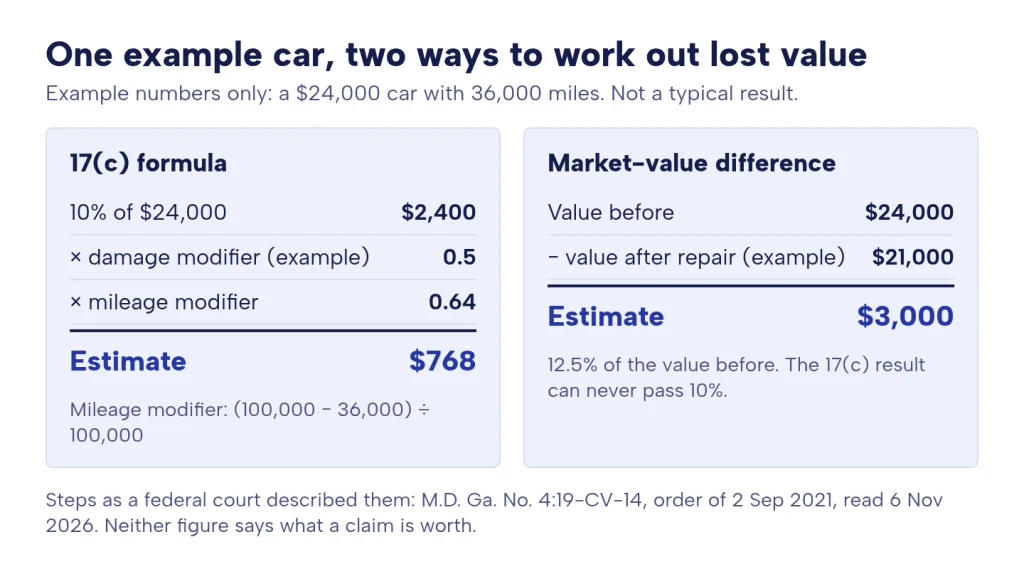
Three things follow from the steps themselves:
- The result can never be more than 10% of the value before. Both modifiers run from 0 to 1, so multiplying by them can only shrink the $2,400 base in the example.
- At or over the mileage maximum, the result is zero. A car at 104,500 miles on a 100,000-mile scale gets a mileage modifier below zero, which we show as 0, so the formula gives $0 however serious the damage.
- Mileage enters twice. The dealer-guide value that sets the base already allows for mileage, and then mileage sets the modifier. The plaintiffs’ expert in Baker made this point, together with the 10% ceiling and the zero above the maximum, as a criticism. The court did not decide whether the formula was right or wrong for any one car.
If the car had earlier damage that the current claim doesn’t cover, the court said the insurer runs a second 17(c) calculation to account for it. This tool doesn’t do that step.
Where the name 17(c) comes from
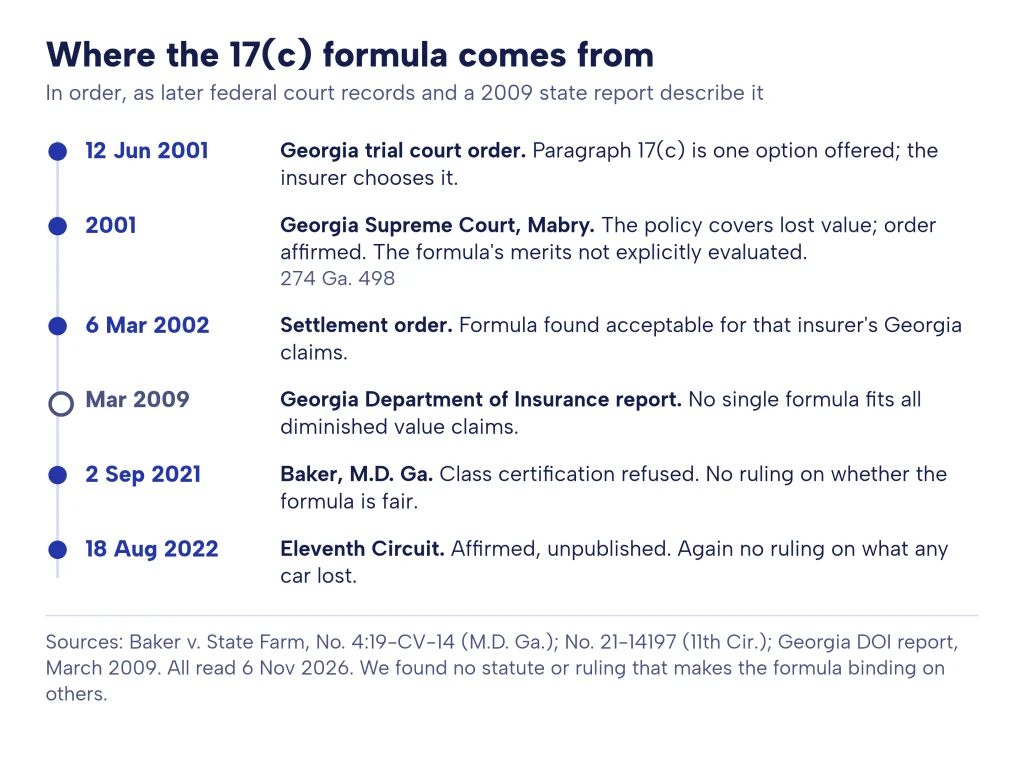
The name goes back to a Georgia class action against one insurer, State Farm Mutual Automobile Insurance Co. v. Mabry, 274 Ga. 498 (2001). We couldn’t find the Georgia Supreme Court’s Mabry opinion or the trial court’s orders on an official court site. What follows comes from two later federal court records that quote them, both read on official court sites on 6 November 2026:
- The Georgia Supreme Court held in Mabry that the insurer’s car policy covered post-repair diminution in value, and that the insurer had to assess it when a policyholder made a claim. In its words, “value, not condition, is the baseline for the measure of damages”, and an option to repair “serves only to abate, not eliminate, the insurer’s liability for the difference between pre-loss and post-loss value” (274 Ga. at 506, as quoted by the Georgia Supreme Court in Royal Capital Development v. Maryland Casualty, No. S12Q0209 (Ga. 29 May 2012), reprinted by the Eleventh Circuit).
- The insurer had no method for this at the time. The trial court ordered it to develop one and gave it several options. One was the formula set out in paragraph 17(c) of the trial court’s order of 12 June 2001, which that order described as a formula distributed by the Georgia Insurance Commissioner’s office and used by several other insurers and a claims firm. The insurer chose it, and that paragraph number is where the name comes from (Baker order, pages 4 and 5).
- The Georgia Supreme Court affirmed the trial court’s order granting declaratory and injunctive relief. The Baker court notes that it “did not explicitly evaluate the merits of the 17(c) formula.”
- When the class action settled, the trial court’s order of 6 March 2002 found the formula “an acceptable methodology for assessing diminished value claims” for the settlement class and for that insurer’s future Georgia claims, and ordered the insurer to keep using it. The Baker court said in 2021 that it still did.
- The court-approved process let the policyholder reject the formula’s figure and present other evidence of lost value, and litigate if no agreement was reached (Baker order, pages 1, 2 and 7).
Georgia’s insurance department has said separately that insurers must not suggest it endorsed any formula. Its Insurance and Safety Fire Report of March 2009 reported a directive from the Commissioner ordering all auto insurers “to cease using any language that implies that the Department of Insurance has endorsed or approved a particular formula”, and said that “no single formula can be applied to all diminished value claims.” We read that report in the Georgia government publications collection of the Digital Library of Georgia. We couldn’t open the directive itself.
So the 17(c) formula is a method one Georgia court approved for one insurer’s Georgia claims, under a settlement. We found no statute, regulation or court ruling that makes it binding on other insurers, on courts or in other states. You may see pages calling it the industry standard that most insurers use. We looked for a study or an official source behind that and didn’t find one.
What the 2021 and 2022 rulings decided, and didn’t
In Baker, Georgia policyholders argued that the formula always undervalues diminished value, and they asked to sue as a class. Their expert, an appraiser, named the three features listed above. The district court refused to certify the class. It found the expert’s sample of 75 claims too small and too unlike the proposed class to show that the formula was wrong for every claim. It also found that the only method in the record for showing whether a policyholder was underpaid was to compare the 17(c) figure with an individual appraisal of that car, so the question could not be answered for the whole class at once.
The Eleventh Circuit affirmed on 18 August 2022 (No. 21-14197, unpublished). It said that “Dr. Hixenbaugh identified some fundamental flaws with the 17(c) formula,” but that this didn’t show the formula always produced an underpayment. Neither court decided whether the formula is fair or what any particular car lost. In the two named policyholders’ cases, the district court said, their own appraisers and the insurer’s expert all put the loss well above the 17(c) figure. That is the court’s account of two cars, not a pattern you can apply to your own.
The market-value method
The second line in the calculator is the measure from Mabry: in the Baker court’s summary of that case, diminution in value “is generally calculated as ‘the difference between pre-loss value and post-repair value.’” The arithmetic is simple. The hard part is the two numbers, and the result is only as good as the evidence behind each one.
- Value before. The car’s market value just before the crash, for its year, trim, options, mileage and condition. Keep a dated printout or a written figure, not a remembered one.
- Value after repair. What a buyer would pay now for the same car with a repaired-damage history. In the Baker records, both sides used appraisers for this. Written dealer offers that mention the repair history are another kind of evidence. Keep everything in writing and dated.
- Keep the two figures on the same basis. A retail figure before and a trade-in offer after will produce a gap that is partly just the difference between retail and trade-in prices.
We don’t give a “usual” percentage for lost value. We found no public dataset of diminished value payments, and the percentages we saw online, on appraiser, calculator and law firm sites, showed no source. Some online calculators also add mileage bands, brand multipliers or state multipliers. None of those appear in the court records we read, and the calculators we checked show no source for them, so this tool leaves them out.
Your insurer or the other driver’s
Whether anyone pays for lost value depends first on who you are claiming against, and the answer differs between the two kinds of claim:
- Your own policy (a first-party claim). It turns on the policy’s wording and your state’s law. In Georgia, Mabry read one insurer’s car policy as covering lost value. In 2012 the Georgia Supreme Court said that whether such damages are recoverable under a given contract “depends on the specific language of the contract itself” (Royal Capital, as reprinted by the Eleventh Circuit). Texas is an example of the opposite reading. In Bulletin B-0027-00 of 6 April 2000, still posted on its site, the Texas Department of Insurance said that, under the standard Texas auto policy the department had adopted at the time, an insurer is not obligated to pay its own policyholder for diminished value when the car is completely repaired to its pre-damage condition. We haven’t checked whether every Texas policy sold today uses that wording.
- The at-fault driver’s insurer (a third-party claim). The same Texas bulletin says an insurer “may be obligated to pay a third party claimant for any loss of market value of the claimant’s automobile, regardless of the completeness of the repair,” and may owe its own policyholder for lost market value under uninsured or underinsured motorist coverage. That is one state agency’s position from 2000, not a national rule.
We haven’t yet read each state’s law on diminished value claims, so this page gives no state-by-state answer. Our guide to making a diminished value claim adds state rows only where we have read the statute or the court’s opinion. If the car is a total loss rather than repaired, diminished value doesn’t apply in the same way: see what happens when a car is totaled but still drivable.
Time limits still run
A property damage claim against another driver has a time limit to sue, set by state law. It can differ from the period for an injury claim, and for some states we have not yet confirmed which period applies to crash damage to a car. A claim under your own policy can also have deadlines written into the policy. We don’t give a property damage period here. Our deadline lookup by state shows the rules we have read, with their statutes and read dates, and says “not confirmed” where we haven’t. Some states have exceptions, and a claim against a government vehicle can need a written notice within months. Waiting until the last day is unsafe. Ask the court clerk or a lawyer about yours.
What the calculator can’t tell you
- It doesn’t say what your car lost in value, what a claim is worth or what an insurer must pay. It does arithmetic on your entries.
- It doesn’t say which method an insurer, an appraiser or a court would use for your claim, or which one is right.
- It doesn’t pick your damage severity modifier. Where a modifier came from an insurer, ask how they chose it.
- It doesn’t handle earlier damage to the same car, or a total loss.
What to gather next
- Get the insurer’s figure in writing. If an insurer has assessed diminished value, ask in writing for the method, the value before it used, the mileage maximum and the damage modifier. In the Baker records, one insurer’s letter said it had used “a formula authorized for that purpose by a Georgia court.”
- Keep the repair file: the estimate, the final invoice, the parts list, and photos of the damage and the finished repair. Structural work and replaced panels matter to both methods.
- Keep dated evidence of both values: the value before from a named, dated source, and the value after from a written appraisal or written offers.
- Read the physical damage part of your policy for what it says about loss of value and for any appraisal or dispute process, and note any time limit it sets.
- Check the time limit for the claim in the deadline lookup above or with the court clerk. Don’t wait for talks with an insurer to end before you find out.
- If you’re stuck, your state’s insurance department takes consumer complaints about claim handling. A lawyer, or legal aid if you qualify, can say how your state treats diminished value. Our page on what an adjuster does explains who you’ll be dealing with.
Sources checked on 6 November 2026. Court records read on govinfo.gov and the Eleventh Circuit’s site; the Georgia report in the Digital Library of Georgia’s government publications collection; the Texas bulletin on the Texas Department of Insurance site. The Mabry opinion and the 2001 and 2002 trial court orders were not available on an official site, and are described here only as later court records quote them.
Formulas and sources
- Base loss of value: 10% of the value before: Baker v. State Farm, No. 4:19-CV-14 (M.D. Ga. 2 Sep 2021), order on class certification, pp. 4-7
- Damage severity modifier entered: Baker v. State Farm, No. 4:19-CV-14 (M.D. Ga. 2 Sep 2021), order on class certification, pp. 4-7
- Mileage modifier: (maximum miles – miles) / maximum miles, not below 0: Baker v. State Farm, No. 4:19-CV-14 (M.D. Ga. 2 Sep 2021), order on class certification, pp. 4-7
- Estimate by the 17(c) formula: base x damage modifier x mileage modifier: Baker v. State Farm, No. 4:19-CV-14 (M.D. Ga. 2 Sep 2021), order on class certification, pp. 4-7
- 17(c) estimate as a share of the value before: Arithmetic on the reader's own entries, no outside figure
- Market-value difference: value before minus value after repair: Royal Capital Dev. v. Maryland Cas. Co., No. S12Q0209 (Ga. 29 May 2012), quoting Mabry, 274 Ga. at 506 (appendix to 11th Cir. No. 10-15716)
- Market-value difference as a share of the value before: Arithmetic on the reader's own entries, no outside figure
- Market-value difference minus the 17(c) estimate: Arithmetic on the reader's own entries, no outside figure
- Base loss of value as a share of the value before (17(c) formula) (0.1, as of 2026-11-06): Baker v. State Farm, No. 4:19-CV-14 (M.D. Ga. 2 Sep 2021), order on class certification, pp. 4-7
Sources
- Baker v. State Farm, No. 4:19-CV-14 (M.D. Ga.), order on class certification, 2 Sep 2021 (govinfo.gov, read 6 Nov 2026)
- Baker v. State Farm, No. 21-14197 (11th Cir. 18 Aug 2022), unpublished (read 6 Nov 2026)
- Royal Capital Dev. v. Maryland Cas. Co., No. 10-15716 (11th Cir. 2 Aug 2012), with the Georgia Supreme Court's opinion S12Q0209 of 29 May 2012 as appendix (read 6 Nov 2026)
- Georgia Department of Insurance, Insurance and Safety Fire Report, March 2009, Digital Library of Georgia (read 6 Nov 2026)
- Texas Department of Insurance, Commissioner's Bulletin B-0027-00, Payment of Diminished Value to Policyholders, 6 Apr 2000 (read 6 Nov 2026)